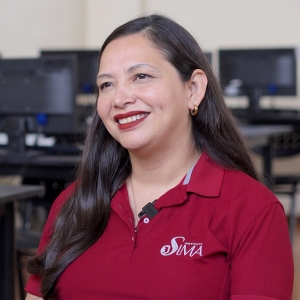
TANIA RAMÍREZ
Academic Director
SIMA Institute
Monterrey, México
When we decided to transform the way science was taught at our school, we knew we wanted much more than simply replacing a textbook with a digital platform. We were looking for a teaching approach that would help our students develop critical thinking, understand scientific phenomena, and learn in a far more meaningful way. That’s how we discovered Science Bits.
My name is Tania Ramírez, and I serve as Academic Director at SIMA Institute. Part of my role is overseeing the implementation of our academic programs, supporting our teachers, and working closely with families to ensure that our students receive the best education possible. From the very beginning, I recognized that Science Bits represented a major shift in the way we teach middle school science.
I won’t pretend that implementation was easy. In fact, one of the first things we noticed was that the program demanded more from our students than they were accustomed to. At first, they struggled with questions that didn’t have immediate answers and with a methodology that required them to analyze, reflect, and construct their own explanations.
In the end, however, that initial challenge became one of the program’s greatest strengths.
As the school year progressed, students stopped seeing those challenges as obstacles and began incorporating them into the way they approached learning. Gradually, they learned to question, investigate, and solve problems through logical reasoning. That shift in mindset was exactly what we had hoped to achieve when we decided to adopt a new approach to teaching science in middle school.
One of the factors that contributed most to our success was having an exceptionally well-prepared teaching staff. Our teachers embraced the methodology with remarkable ease and adapted it naturally to their classrooms. When teachers truly understand the purpose behind a program and make it their own, the impact on student learning is far greater.
We also needed to make some adjustments to our school’s infrastructure. Because our educational model is not fully digital, we created dedicated spaces for working with the platform. We established one classroom specifically for Science Bits and another for Math Bits. This organization allowed us to integrate digital learning resources efficiently without disrupting the rest of the school’s operations.
Over time, we began to see results that extended well beyond students’ grades.
What changed most was the way our students approached problems. Instead of looking for quick answers, they began asking better questions. For me, that growth in critical thinking is one of the greatest achievements of the entire project.
Our academic results also reflect that transformation. At our school, students take the PAA, the admissions assessment widely used in Mexico for entry into upper secondary education, and year after year they achieve outstanding results. They also earn scholarships at many of Monterrey’s leading educational institutions. Most recently, 38% of our students received scholarships, and historically we have maintained an average of about 41%.
I am convinced that these results are not simply the product of our students’ and teachers’ hard work. They are also the outcome of using a methodology that promotes meaningful learning, develops scientific competencies, and prepares students to analyze evidence, construct arguments, and solve problems—skills that are essential in today’s world.
Another decision also proved to be pivotal. We realized that the greatest challenge arose when students first encountered the platform in middle school. For that reason, we decided to introduce it a year earlier, in sixth grade. Students begin by using the program in Spanish so they can become familiar with the methodology. Then, when they enter middle school, they continue working with both Science Bits and Math Bits in English.
That seemingly small change completely transformed the transition from elementary to middle school. Today, students arrive already familiar with the lesson structure, the inquiry-based approach grounded in the scientific method, and the way the platform works. Rather than spending time adapting to a new methodology, they can focus from the very first day on understanding science and developing new competencies.
Looking back, I am convinced that adopting Science Bits was far more than an investment in educational technology. It was a commitment to transforming the way science is taught in middle schools across Mexico.